
Quick answer
Pigeon Pose is a deep hip opener in which you bring one shin forward on the mat and extend the other leg straight back, then fold forward over the front leg. It stretches the outer hip and glutes of the front leg and the hip flexors of the back leg. Hold 1 to 3 minutes per side, using a block or blanket under the front hip for support.
Contains affiliate links. As an Amazon Associate we earn from qualifying purchases. Disclosure
| Sanskrit name | Eka Pada Rajakapotasana prep (AY-kah PAH-dah rah-jah-kah-poh-TAHS-uh-nuh) |
|---|---|
| English name | Pigeon Pose, Half Pigeon, Sleeping Pigeon |
| Pose type | Seated hip opener, forward fold |
| Level | Beginner to intermediate (with props) |
| Targets | Outer hip, glutes, piriformis, hip flexors, thighs |
| Hold time | 5 breaths to 3 minutes per side |
| Drishti (gaze) | Forward when upright, down or eyes closed when folded |
Pigeon Pose is famous for one reason: it reaches tight hips like few other shapes can. Runners, cyclists and anyone who sits all day often feel it right away, sometimes in a big way.
The version most classes teach is technically a preparation for the full King Pigeon (Eka Pada Rajakapotasana), a deep backbend. In this guide you will learn the common prep version step by step, plus Reclined Figure Four, a gentler alternative that gives a similar stretch with far less pressure on the knees.
How Do You Do Pigeon Pose?
- Start in Downward Dog or tabletop. From Downward Dog, lift your right leg behind you.
- Bring the right knee forward. Place your right knee on the mat behind your right wrist. Let your right foot rest somewhere in front of your left hip. Beginners usually keep the foot close to the body.
- Extend the back leg. Slide your left leg straight back, top of the foot on the floor, with the kneecap and toes pointing straight down.
- Level your hips. Square your hips toward the front of the mat. If your right hip floats high, slide a block or folded blanket under it so you are evenly supported.
- Lengthen upright. Press your fingertips into the mat beside your hips and lift your chest for 3 to 5 breaths.
- Fold forward if it feels right. Walk your hands forward and lower onto your forearms, a block or the floor. Keep the spine long rather than collapsing.
- Breathe and stay. Hold for 5 breaths in an active practice or 1 to 3 minutes in a slower one. Then press back to Downward Dog and switch sides.

Teacher tip: Flex the front foot (toes pulled toward the shin). It helps stabilize the ankle and knee so the stretch goes into the hip, where you want it.
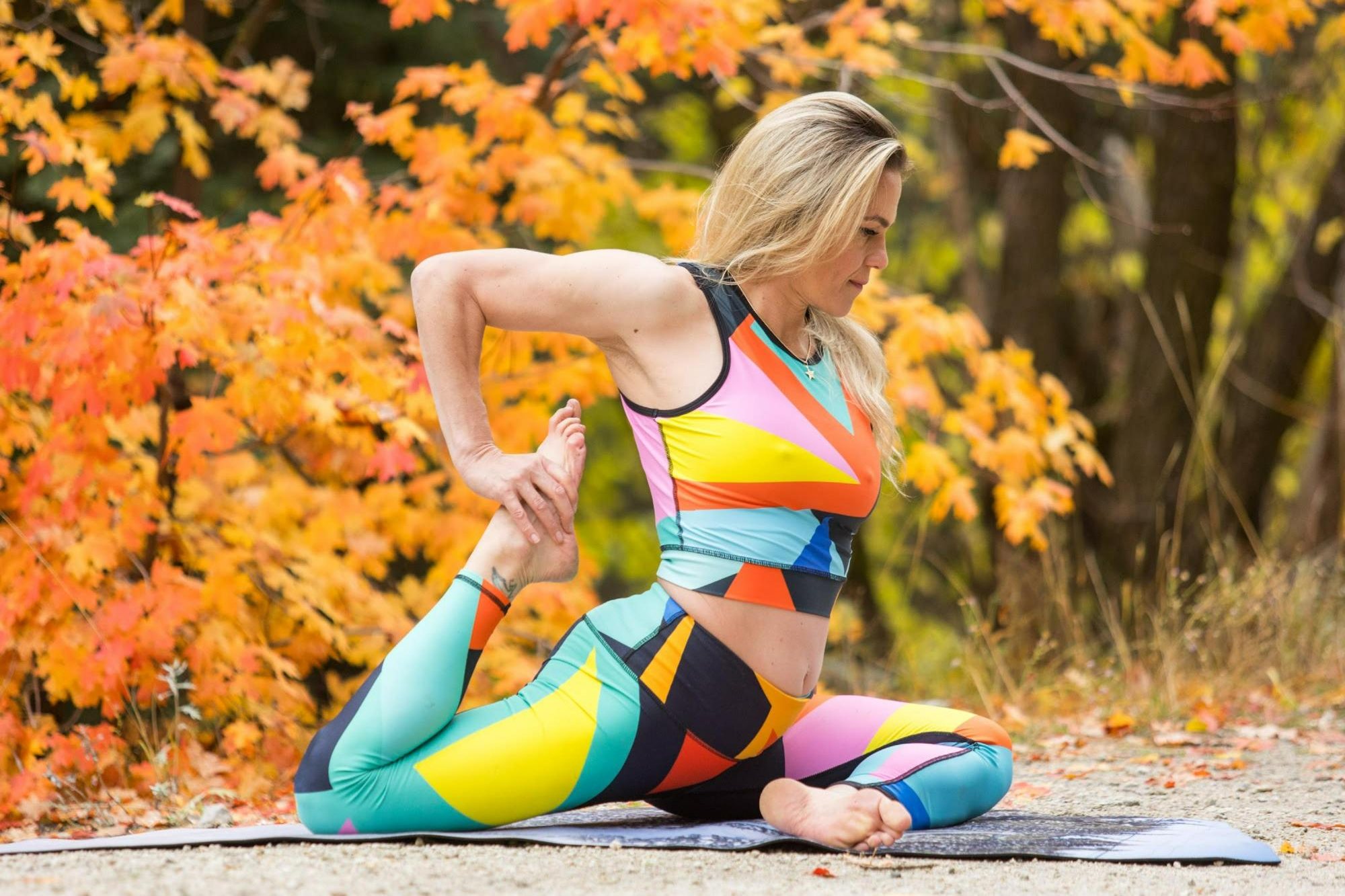
What Is the Reclined Figure Four Alternative?
Reclined Figure Four (sometimes called Supine Pigeon or Eye of the Needle) gives a similar outer hip stretch while you lie on your back. It is a great choice for sensitive knees, beginners and anyone who finds full Pigeon too intense.
- Lie on your back with both knees bent and feet flat on the floor.
- Cross your right ankle over your left thigh, just above the knee. Flex your right foot.
- Lift your left foot and thread your right hand between your legs. Clasp behind your left thigh or shin.
- Draw the legs toward you until you feel a stretch in the right hip. Keep your head and shoulders relaxed on the floor.
- Hold 1 to 2 minutes, then switch sides.
If you cannot reach comfortably, keep your left foot on the floor or place it on a wall. You get the stretch with no effort in the arms.
What Are the Benefits of Pigeon Pose?
- Opens the outer hips. It stretches the glutes and deep hip rotators, areas that often feel tight after sitting, running or cycling. See yoga for runners.
- Stretches the hip flexors. The back leg gets a gentle front hip stretch at the same time.
- Supports overall mobility. Regular hip work is a core part of yoga for flexibility.
- Encourages relaxation. Long, quiet holds in the folded version can feel calming, which is why variations appear in Yin Yoga.
- May ease buttock tightness. Some people use it as part of a routine for tight piriformis muscles. If you have sciatic symptoms, read yoga for sciatica and talk to your doctor first.
What Are the Most Common Pigeon Pose Mistakes?
| Mistake | Why it matters | Fix |
|---|---|---|
| Front hip tilting to the floor | Twists the pelvis and can strain the low back and knee | Prop the front hip with a block or blanket |
| Forcing the shin parallel to the mat | Puts torque on the front knee | Keep the front foot closer to your pelvis |
| Back leg rolled out to the side | Loses the hip flexor stretch | Point the back kneecap and toes straight down |
| Sickled, floppy front foot | Leaves the ankle and knee unstable | Flex the front foot |
| Pushing through knee pain | Knee pain signals stress in the joint, not a hip stretch | Back off or switch to Reclined Figure Four |
How Can You Modify Pigeon Pose?
- Block or blanket under the front hip: The single most helpful prop for keeping the pelvis level.
- Bolster under the torso: Rest your chest on a bolster or stacked blocks for a restful fold.
- Blanket under the back knee: Adds padding for sensitive kneecaps.
- Stay upright: You do not have to fold forward. Staying tall on your fingertips still stretches both hips.
- Chair version: Sit on a chair and cross one ankle over the opposite knee, then hinge forward slightly. This is useful in desk yoga.
What Are Some Pigeon Pose Variations?
- Sleeping Pigeon: The fully folded version, often held for several minutes.
- Quad stretch Pigeon: From upright, bend the back knee and reach back for the foot to add a thigh stretch.
- Full King Pigeon: An advanced backbend in which the back foot reaches toward the head. Only explore it with a teacher and a warm, well-prepared body.
- Standing Figure Four: Balance on one leg, cross the other ankle over the standing knee and sit back as if into Chair Pose.
Who Should Avoid Pigeon Pose or Take Extra Care?
- Knee injuries or knee pain: Choose Reclined Figure Four instead.
- Hip injuries, hip replacements or sacroiliac joint pain: Check with your doctor or physical therapist about safe ranges.
- Ankle injuries: Pad the ankle or use the reclined version.
- Pregnancy: Many people use a well-propped Pigeon, but relaxin can make joints looser, so avoid pushing into your end range. Your care provider can advise you.
Be careful: You should feel Pigeon in the hip and buttock. Sharp, pinching or twisting sensation in the knee is a sign to come out right away.
What Are the Best Preparatory and Counter Poses for Pigeon?
Preparatory poses: Warm up with Cat-Cow, Downward Dog, Reclined Figure Four and a lunge to open the hip flexors.
Counter poses: Afterward, rest in Child’s Pose or lie on your back in Happy Baby. A gentle windshield wiper of the knees also helps reset the hips. Find more shapes in our A to Z pose library.
Props for Pigeon
- Cork yoga blocks: bring the floor closer in standing and seated poses
- Yoga bolster: supports long, restful holds
- Yoga blanket: padding for knees and warmth during rest
Affiliate links. We may earn a commission.
Key Takeaways
- Pigeon stretches the outer hip of the front leg and the hip flexors of the back leg.
- Prop the front hip so your pelvis stays level.
- Keep the front foot flexed and the back leg pointing straight back.
- Feel it in the hip, never in the knee.
- Reclined Figure Four is an excellent, knee-friendly alternative.
Frequently Asked Questions
How long should you hold Pigeon Pose?
In a flowing class, 5 to 10 breaths per side is common. In slower or Yin-style practice, 1 to 3 minutes per side works well if you are comfortable.
Why does Pigeon Pose hurt my knee?
Usually the hip is not rotating enough, so the knee absorbs the twist. Bring the front foot closer to your body, prop the hip, flex the foot or switch to Reclined Figure Four.
Is Pigeon Pose good for beginners?
Yes, with props. Beginners usually do best with a block under the front hip, or by starting with Reclined Figure Four.
What is the difference between Pigeon and Figure Four?
Both stretch the outer hip. Pigeon is done face down with the back leg extended, which adds a hip flexor stretch. Figure Four is done lying on your back and puts much less load on the knee.
Why do people get emotional in Pigeon Pose?
Many practitioners report feeling emotional during long hip openers. Explanations vary and are not well studied, so simply notice what comes up and breathe slowly.
Should my front shin be parallel to the front of the mat?
Only if your hips are very open. For most people, angling the shin so the foot sits closer to the opposite hip is safer for the knee.
This article is for educational purposes and is not medical advice. Check with a qualified healthcare provider before starting a new exercise program, especially if you are pregnant, injured or managing a health condition.


